
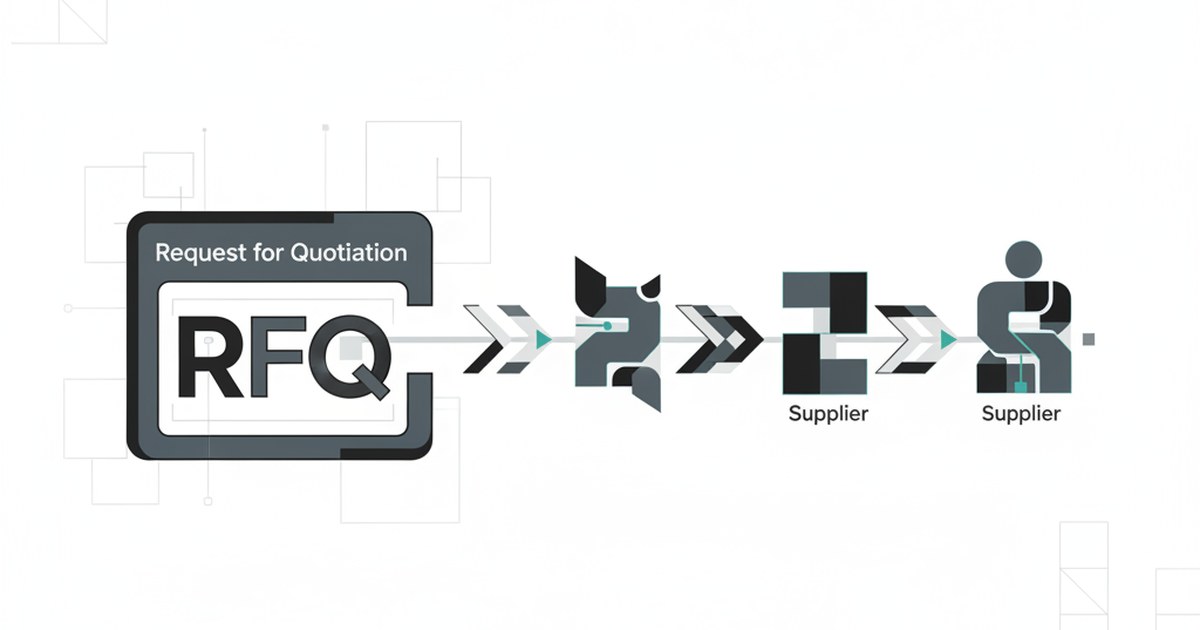
RFQs that lack clarity and depth produce supplier responses that are equally vague and uncompetitive. By improving the RFQ process—establishing clear expectations, enabling supplier dialogue, and defining evaluation criteria—procurement teams can directly influence the quality of bids they receive, reduce costs, and build stronger supplier relationships.
Key Terms and Definitions
| Term | Definition |
|---|---|
| RFQ (Request for Quote) | A formal document issued by a buyer to solicit pricing and delivery proposals from suppliers for specific goods or services |
| Supplier behavior | The pattern of responsiveness, bid quality, compliance, and collaboration a supplier demonstrates during and after the RFQ process |
| Evaluation criteria | The explicit metrics and standards a procurement team uses to assess and compare supplier bids |
| Bid quality | The completeness, accuracy, competitiveness, and compliance of a supplier’s response to an RFQ |
| Supplier dialogue | Structured communication between the buyer and supplier during the RFQ process, including Q&A sessions and clarification requests |
How RFQ Quality Directly Influences Supplier Behavior
The quality of an RFQ determines the quality of the bids a procurement team receives. This relationship operates through three mechanisms:
- Signal of buyer seriousness — A detailed RFQ signals to suppliers that the buyer is organized and expects professional engagement. Suppliers allocate more effort to bids when they perceive a structured evaluation process.
- Reduction of ambiguity — When requirements for materials, costs, delivery timelines, and terms of service are explicitly stated, suppliers can respond with precise, competitive proposals instead of hedging with inflated pricing.
- Establishment of a competitive baseline — A well-defined RFQ makes it possible for suppliers to understand exactly what is being compared, which drives more competitive bids.
| RFQ Characteristic | Supplier Response When Absent | Supplier Response When Present |
|---|---|---|
| Detailed material specifications | Vague line items with inflated pricing | Precise quotes aligned to exact requirements |
| Defined delivery timelines | Non-committal lead time estimates | Firm delivery commitments |
| Explicit terms of service | Boilerplate contract language | Tailored terms addressing buyer needs |
| Stated evaluation criteria | Generic proposals optimized for volume | Targeted proposals optimized for stated priorities |
Key Takeaway: A detailed RFQ reduces ambiguity for suppliers, which directly increases bid quality, pricing competitiveness, and response completeness.
Setting Clear Expectations in the RFQ
Clear expectations shape supplier behavior throughout the engagement process. When procurement teams define acceptable standards upfront, suppliers can align their responses accordingly rather than guessing at requirements.
Expectations that should be explicit in every RFQ include:
- Compliance certifications — Specify required certifications (ISO, industry-specific standards) and request verification documents as part of the bid submission
- Quality standards — Define acceptable tolerance ranges, testing requirements, and inspection protocols
- Delivery requirements — State delivery windows, packaging standards, and logistics constraints
- Contract terms — Outline payment terms, warranty expectations, and penalty structures for non-compliance
This clarity is particularly important in sectors like manufacturing and construction, where compliance failures have significant operational and financial consequences. Establishing criteria upfront reduces risks associated with non-compliance and improves supplier reliability.
Key Takeaway: Explicit expectations in the RFQ eliminate guesswork for suppliers, increase compliance rates, and reduce post-award disputes caused by misaligned assumptions.
Enabling Supplier Dialogue During the RFQ Process
An underutilized element of the RFQ process is structured supplier dialogue—inviting suppliers to ask questions, request clarifications, and engage in discussions about the RFQ before submitting bids.
Supplier dialogue improves bid quality in three ways:
- Clarifies ambiguous requirements — Suppliers surface areas of the RFQ that are unclear, giving the procurement team an opportunity to refine the document before bids are submitted
- Surfaces cost-saving alternatives — Suppliers with domain expertise may propose alternative materials or approaches that meet performance standards at lower cost
- Builds long-term relationships — Engagement during the RFQ process signals to suppliers that the buyer values their expertise, which encourages investment in the relationship beyond a single transaction
Example: An electronics manufacturer struggling with fluctuating prices issued a detailed RFQ and held a Q&A session with suppliers. The dialogue led to more refined bids and encouraged suppliers to propose alternative materials that met performance standards while being more cost-effective.
Key Takeaway: Structured supplier dialogue during the RFQ process improves bid quality, surfaces cost-saving alternatives, and strengthens buyer-supplier relationships.
Defining Evaluation Criteria to Promote Supplier Accountability
When procurement teams publish the criteria by which bids will be evaluated, suppliers understand what matters most and can tailor their proposals accordingly. Transparent evaluation criteria promote accountability by making the competitive landscape visible to all participants.
Effective evaluation criteria should include:
- Quality metrics — Product specifications, defect tolerances, and testing standards
- Total cost — Unit pricing, shipping costs, volume discounts, and total cost of ownership
- Lead times — Production timelines, delivery schedules, and responsiveness to schedule changes
- Past performance — Historical delivery accuracy, quality records, and responsiveness
| Evaluation Approach | Effect on Supplier Behavior |
|---|---|
| Vague or unstated criteria | Suppliers optimize for lowest price, ignore quality and compliance |
| Criteria published but not weighted | Suppliers address all factors but cannot prioritize effectively |
| Weighted criteria shared with suppliers | Suppliers allocate effort to the factors the buyer values most, producing higher-quality bids |
Explicit evaluation criteria create an upward spiral of improvement. Suppliers that meet expectations build a track record that benefits them in future RFQ cycles, which incentivizes consistent performance beyond a single bid.
Key Takeaway: Publishing weighted evaluation criteria aligns supplier effort with buyer priorities, increases bid quality, and creates accountability that extends beyond the current RFQ.
Measurable Outcomes of Structured RFQs
Investing in RFQ quality produces measurable business outcomes that extend beyond the immediate bid cycle.
| Outcome | How Structured RFQs Contribute |
|---|---|
| Lower operational risk | Clear requirements reduce post-award scope disputes and change orders |
| Faster supplier response times | Unambiguous RFQs require less back-and-forth clarification |
| Improved bid quality | Explicit criteria drive more complete, competitive supplier proposals |
| Reduced supplier onboarding time | Expectations defined upfront reduce the learning curve for new suppliers |
| More favorable contract terms | Transparent processes build supplier trust, which leads to better pricing and value-added services |
| Stronger supplier loyalty | Suppliers who feel respected through a structured RFQ process invest more in the relationship |
Key Takeaway: Structured RFQs reduce operational risk, improve bid quality, and create supplier relationships that generate compounding value over time.
RFQ Improvement Checklist
- Define material specifications, delivery timelines, and terms of service explicitly in every RFQ
- Include required compliance certifications and request verification documents
- Publish weighted evaluation criteria with the RFQ
- Schedule a supplier Q&A session before the bid submission deadline
- Establish a structured feedback channel for suppliers to request clarifications
- Conduct post-award reviews to assess supplier performance against bid commitments
- Use bid performance data to refine evaluation criteria for future RFQ cycles
Frequently Asked Questions
How does a detailed RFQ reduce procurement costs? A detailed RFQ reduces costs by eliminating ambiguity that causes suppliers to inflate pricing as a risk hedge. When requirements are explicit, suppliers can price precisely against known specifications rather than padding quotes to cover undefined scope. Additionally, clear evaluation criteria increase competitive pressure by making the comparison transparent to all bidders.
What is the most common RFQ mistake that leads to poor supplier behavior? The most common mistake is omitting evaluation criteria from the RFQ. When suppliers do not know how bids will be assessed, they default to generic proposals optimized for the lowest price rather than the factors the buyer actually values—such as quality, lead time, or compliance.
How does supplier dialogue during the RFQ process improve bid quality? Supplier dialogue allows vendors to clarify ambiguous requirements before submitting bids. This reduces the number of non-compliant or misaligned proposals. It also gives suppliers the opportunity to propose alternatives that may better meet the buyer’s performance and cost objectives.
Should evaluation criteria be weighted and shared with suppliers? Yes. Sharing weighted evaluation criteria with suppliers aligns their effort with buyer priorities. A supplier that knows quality is weighted at 40% and price at 30% will allocate proposal effort differently than one that assumes price is the only factor. This produces bids that are more relevant to the buyer’s actual decision framework.
How often should a procurement team review and update its RFQ templates? RFQ templates should be reviewed after every major sourcing cycle and formally updated at least quarterly. Post-award reviews frequently reveal gaps in the RFQ—missing specifications, unclear terms, or evaluation criteria that did not differentiate effectively between suppliers. Incorporating these lessons keeps RFQ templates current and effective.